

Have you ever wondered what might happen if you start a new job without giving your employer your P45? Could it affect your pay? Would you pay more tax? And can you even start work without it?
For many UK employees, the P45 is a piece of paperwork they don’t think much about until they leave a job. Yet it plays a crucial role in ensuring your taxes are calculated correctly from your very first payday in a new role.
Without it, your new employer cannot access your tax history for the current financial year and may have to use an emergency tax code. This could mean you temporarily pay more tax than necessary until your details are corrected.
In this guide, we will explore exactly what happens when you do not provide your P45, why it matters, and what steps you can take to avoid unnecessary deductions from your salary.
Why is P45 important?
A P45 is an official document issued by your employer when you leave a job in the UK. It is not a goodwill gesture but a legal requirement under HMRC rules. The document contains essential information about your earnings and tax for the current tax year, including your tax code, your total pay to date, and how much tax has been deducted.
Your new employer uses this document to ensure you are placed on the correct tax code immediately. Without it, they cannot accurately determine how much tax you have already paid, which can lead to errors and overpayments.
It is also important to note that a P45 is not only issued when you leave to take another job. You should receive one if you retire, are made redundant, or are dismissed for any reason. It is your right to be provided with this document, regardless of the circumstances under which you leave employment.
What Happens If You Start a New Job Without a P45?

It is entirely possible to start a new job without a P45, but it does have implications. Without this document, your employer has no record of your previous income and tax for the current financial year. In such cases, they will have to assign you an emergency tax code or a temporary tax code until HMRC confirms your correct details.
This emergency or temporary code may result in higher tax deductions from your wages. For example, your personal allowance, the amount you can earn before paying income tax—may not be applied in full, meaning you pay tax on more of your income than necessary.
Although this overpayment can usually be reclaimed once your tax code is corrected, it can still impact your immediate take-home pay. In some cases, corrections happen within the next payroll cycle; in others, you may have to wait until the end of the tax year to receive a refund from HMRC.
What Is an Emergency Tax Code and How Does It Work?
An emergency tax code is a temporary measure used by HMRC when your employer does not have enough information about your current tax situation. Common examples include codes such as 1250 W1, 1250 M1, or 1250 X. These codes work on a “Week 1” or “Month 1” basis, meaning your tax is calculated as if each payday is the first in the tax year.
In some cases, the BR (Basic Rate) code may be applied, meaning all your earnings are taxed at 20% with no personal allowance. This is more likely if you have more than one job. Another possibility is the 0T code, which applies no personal allowance and taxes all your earnings at the appropriate rate based on your income level.
While emergency codes prevent underpayment of tax, they are designed to err on the side of collecting more rather than less. This means you could pay more tax than necessary until the situation is corrected.
Some businesses avoid these compliance issues altogether by using a payroll outsource provider, ensuring employees always receive accurate documents like the P45 on time.
Can You Reclaim Tax Paid Under an Emergency Code?
If you have overpaid tax because you were placed on an emergency tax code, you can reclaim it. The method depends on when the correction happens:
When Code Is Corrected | How Refund Is Processed |
During the tax year | Through your employer’s payroll in a future payslip |
After the tax year ends | Directly from HMRC as a tax refund |
In most cases, once your correct details are provided, either through submitting your P45 or HMRC updating your record—the refund is processed automatically. However, delays can occur, so it is wise to check your tax code on your payslip regularly and contact HMRC if you believe it is wrong.
Can You Start Work Without a P45?
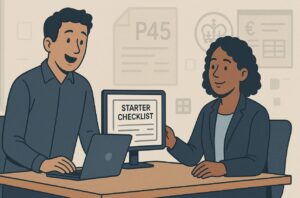
Yes, you can. If you do not have a P45, your new employer will ask you to complete HMRC’s starter checklist. This form collects key information about your current employment situation, such as whether you have other jobs, receive pensions, or have been unemployed. Based on this, HMRC assigns a temporary tax code.
Although this allows you to start working, it still means your first payslip may be affected by emergency tax deductions until the correct information is received.
What Should You Do If Your Employer Doesn’t Issue a P45?
If your previous employer does not issue your P45, you should first contact them directly. It is best to do this promptly after your final day of employment. If they still fail to provide it, escalate the matter to HMRC.
HMRC will contact the employer, and if necessary, investigate their PAYE practices. This is not just an inconvenience for the employer; failing to issue a P45 can have legal and financial consequences for them.
Even without the P45, you can still begin your new job using the starter checklist, but this may lead to temporary overpayment of tax.
How Does Not Providing a P45 Affect Your Salary?
The financial effect of not submitting your P45 can vary depending on the tax code assigned.
Scenario | Tax Code Likely Applied | Impact on Pay | Possible Solution |
No P45 but starter checklist completed | 1250 W1/M1 | Slightly higher deductions | Provide P45 or contact HMRC |
No P45 and no checklist completed | BR | Higher tax on all earnings | Submit missing forms to HMRC |
Incorrect personal details given | 0T or wrong code | Underpayment or overpayment | Correct details with HMRC |
In all cases, you can recover overpaid tax, but the speed of the refund will depend on how quickly the correct information reaches HMRC.
Why Should You Give Your P45 Immediately?
Providing your P45 as soon as you start a new job ensures that your take-home pay is calculated correctly from the very first payday. It reduces administrative work for both you and your employer, avoids the stress of unexpected deductions, and ensures you are fully compliant with HMRC requirements.
Delaying submission may not stop you from working, but it can lead to unnecessary short-term financial loss.
Conclusion – The Importance of Acting Quickly
While you can start a job without a P45, doing so can place you on an emergency tax code and result in higher tax deductions until your tax record is updated. Although overpayments are refundable, the process can take time. The most efficient approach is to obtain your P45 as soon as your employment ends, keep a copy for your records, and hand it to your new employer immediately.
By acting quickly, you avoid unnecessary deductions, maintain accurate tax records, and ensure a smoother transition between jobs.
Frequently Asked Questions
What happens if my old employer refuses to give me my P45?
Contact them formally with a deadline. If they still refuse, report the issue to HMRC, who can take enforcement action.
Can I start a job without a P45?
Yes, by completing HMRC’s starter checklist, but you may be placed on a temporary or emergency tax code.
How long does it take to get a tax refund after an emergency code?
If corrected during the year, refunds are processed in payroll. If after year-end, HMRC issues them directly.
What’s the difference between a P45 and a P60?
A P45 is given when you leave a job; a P60 is an annual summary of your earnings and tax.
Can I get a P45 online?
Only if your employer offers it in digital form; HMRC does not issue P45s directly to employees.
Why does the BR tax code mean I pay more tax?
It taxes all earnings at 20% without any personal allowance.
Do I need a P45 if I’ve been unemployed for a while?
No, but you will need to fill in the starter checklist when beginning a new role.